Wednesday, June 21, 2017

An LV Hanging with an Explorer II


...A Note From A Reader....

Scott's Rolex Watches
An LV Hanging with an Explorer II


Scott Shafer sent in photos of his LV and Explorer II, and said:

Hi Jake-

Just wanted to reach out and say thanks for the hard work. I'm a big fan of your work! The amount of effort you go to, to put together Jake's Rolex Magazine is tremendous. I love checking out the Rolex history as well as the general history lessons I get from you. 

Here are a few pics of some of my Rolex's. 

Scott


Scott, Thanks for sharing your kind words, which I genuinely appreciate very much! I feel the exact same way about the 'general history lessons', in the sense that one of my favorite things about publishing Jake's Rolex World, are the amazing history lessons I get from doing all the research!


Tuesday, June 20, 2017

Brooks Koepka Wins 2017 U.S. Open Golf Tournament


...Rolex Coolness...

Brooks Koepka
Wins U.S. Open Golf Championship Tournament 
Stainless Steel Rolex Daytona


Brooks Koepka won the 117th U.S. Open on Sunday, and in the photo below we see him posing with his trophy, while wearing his stainless steel Rolex Daytona.

Image Courtesy of Richard Hethcote/Getty Images


Image Courtesy of The Boston Herald


Monday, June 19, 2017

Rolex Diretor...Harry Borer Belongs To The Ages


Former Chairman Of The Board


Harry Borer

Belongs To The Ages

1928-2017

Harry Borer, former Chairman of the Board of Directors of Manufacture des Montres Rolex S.A., was born on November 26, 1927 and passed away on June 16, 2017 at age 89. Harry Borer was the son of Emile Borer, who was responsible for developing Rolex's super innovative 'Perpetual' Movement, which was the worlds first commercially viable automatic movement.  Harry Borer was also the grandson of Jean Aegler, who founded Aegler S.A., which began making watch movements for Rolex in 1905. In 1913, with the success and rapid expansion of Rolex, Aegler S.A., became a subsidiary of Rolex S.A., and was renamed, Manufacture des Montres Rolex S.A., and in recent decades was commonly referred to as "Rolex Biel". In 2004, Manufacture des Montres Rolex S.A., was acquired by Rolex in 2004 for an undisclosed amount of money, which has been estimated to be in the amount of several Billion dollars. 


"Rolex is the biggest competition for Rolex." 

—Harry Borer (2017)


Harry Borer went to work for Manufacture des Montres Rolex S.A. in 1961, just after Rolex Founder, Hans Wilsdorf passed away. Harry Borer said, in 2017: "Rolex is the biggest competition for Rolex." Harry Borer took over the Manufacture des Montres Rolex S.A. helm in 1967, after his father Emile Borer passed away, and helped it grow  from 180 employees in 1967, to 2500 employees in 2001. In 2001, when Harry Borer retired, he passed the baton to his son, Daniel Borer who took over as the Chairman of the Board of Manufacture des Montres Rolex S.A., and his daughter Franziska took over as Operations Director.You can read more about Harry Boer in an obituary published on Swissinfo.ch

So who exactly was Harry Borer? Let's hop in the Rolex Time Machine to find out. Before we go back in time, let's take a look at what makes Rolex tick today:


Rolex Headquarters
Geneva, Switzerland 1928

Hans Wilsdorf, the founder of Rolex decided to move Rolex World Headquarters from London, England to Geneva, Switzerland in 1919. Rolex moved to 18 due du Marché, which was located below the Cathédrale Saint-Pierre in Old Geneva. Rolex remained at this location for forty years.


The photo above shows Rolex's Geneva Worldwide headquarters in Geneva, Switzerland in 1928. If you look closely you can see the ROLEX signs on the upper floor of the building, and also notice the unlocked bicycles standing-up next to the sidewalk. It's hard to imagine a world where people would just leave their unlocked bicycles parked next to the sidewalk, but this was the world of Geneva in the late 1920s.

These were clearly humble beginnings, and it is worth noting that today, Rolex is considered to be one of the most successful brands in the world, but it was not alway that way. As a matter of fact, in 1928, in Geneva, Hans Wilsdorf and Rolex were considered to be a Genevan outsider, which caused Rolex to work that much harder to establish itself as a true Genevan brand.


Rolex Headquarters
Geneva, Switzerland 

Rolex worldwide headquarters today is located in Geneva, Switzerland and is the epicenter of all things Rolex. This Rolex facility houses all the senior executives, as well as the international marketing department, and the Rolex R&D design center.

Rolex Headquarters today in Geneva Switzerland


Rolex Plan-Les-Site

Geneva, Switzerland
Rolex Foundry, Case & Bracelet Making Facility

Today, Rolex is a vertically integrated company, which means they produce and manufacture 100% of the components used in their watches. Rolex is headquartered in Geneva, Switzerland, but has facilities located all over Switzerland. 


The photo above shows the Rolex Plan-Les-Quates facility which contains the Rolex foundry where Rolex melts gold, platinum and steel to use in the production of their watches. The photo below shows liquified gold being poured at the Rolex foundry. 


Rolex Plan-Les-Quates site today in Geneva Switzerland


The photo below shows a Rolex technician creating Rolex Gold, by melting down gold to a liquid state so it may be molded into parts for making Rolex watches.


Rolex also builds and assembles Oyster cases and bracelets at the Plan-Les-Quates facility.


Rolex Dial and Bezel Facility

Chêne-Bourg, Switzerland


The Rolex facility in Chêne-Bourg, Switzerland specializes in dial making as well as making watch hands, bezels and crystals. 


Rolex watch cases and bracelets, as well as all parts are made with CNC machines, but all parts are still hand assembled by Rolex trained master watchmakers.


The Rolex facility in Chêne-Bourg workshops also specialize is inserting precious stones onto dials and on bezels as seen below.


Rolex Movement Making Facility

Bienne, Switzerland

In October of 2012, Rolex completed a new manufacturing facility in Bienne, Switzerland that specializes in making all movements for their watches. 

Rolex cases, bracelets and dials have always been made in Geneva, Switzerland, as well as final assembly. Rolex movements have always been made in Bienne, Switzerland. The founder of Rolex, Hans Wilsdorf wrote in his memoirs:

"We want to leave to our factory in Bienne exclusively the production of watch movements, while we ourselves create in Geneva, case models adapted to the refined taste of the Genevans." —Hans Wilsdorf

Many years ago, Hans Wilsdorf made a partial investment in Aegler, and in 2004 Rolex completely bought-out the Aegeler/Borer family to obtain 100% ownership in Aegler S.A. For more than a century Rolex made all movements in Bienne, and then transported them to Geneva for installation into the final casing.

Rolex is one of the most secretive companies in the world, and in 2012, for the first time in history, Rolex  offered a glimpse of their world-class facility where all their watch movements are made. In 2013, Rolex invited me, along with Arial Adams, Benjamin Clymer and James Dowling to be the first journalists in history to tour all four Rolex manufacturing facilities in Switzerland, and I wrote about it extensively in my 3 Part Series titled, "Inside Rolex". The photo below shows the four of us inside the Rolex Campus in Bienne, Switzerland where all the Rolex movements are made. 

Benjamin Clymer, James Dowling, Ariel Adams, and Jake Ehrlich on November 19, 2013
(Hodinkee.com, Timezone.com, ABlogToWatch.com, and RolexMagazine.com)

The first photo below shows the extension of the new Rolex manufacturing facility in Bienne, Switzerland, which now consists of over 250,000 cubic meters of space. 


Rolex Building 7 Completed in 2012 pictured above


All movement parts, from hairsprings to mainplates, are made in Bienne. Rolex does not publish their annual production output, but it is estimated approximately 2000 employees produce 50 million movement components annually–which end up in more than 750,000 Rolex automatic movements assembled per year in Bienne. 

[Note: How do we know that Rolex produces more than 750,000 movements annually, if Rolex is a privately-held company that does not publish such numbers? Because the Contrôle Officiel Suisse des Chronomètres, is required to publish the exact number of movement (COSC) certificates for each brand, and in 2011, they published Rolex figures at 751,000 COSC movements.]

Before the movements are installed into Rolex cases in Geneva, they first travel to the Contrôle Officiel Suisse des Chronomètres, where they are tested for Swiss Chronometer accuracy, and assuming they pass, are award the prestigious  C.O.S.C. certification.

This next photo shows the entire Rolex campus located in Bienne, Switzerland, in an industrial section, known as Champs-de-Boujean, with the Jura mountain range seen in the background.


Before we examine the all new extension, let's take a trip back in the Rolex Time Machine to learn about the history of Rolex movement making in Bienne, Switzerland.


Hans Wilsdorf

Founder of Rolex

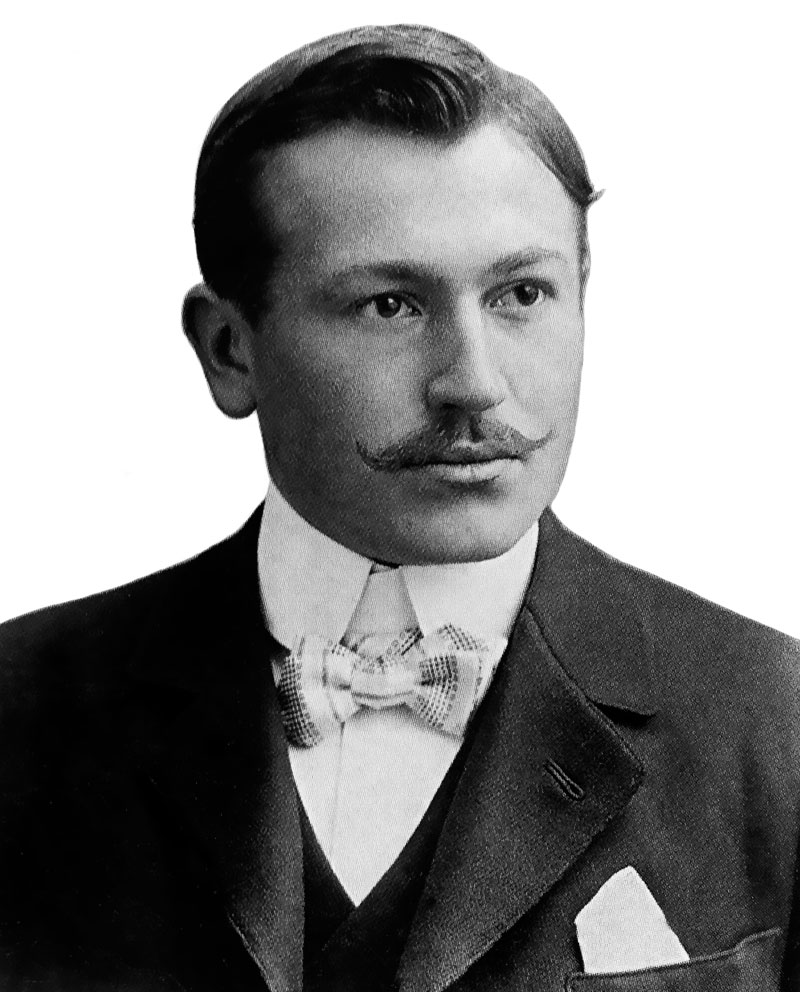
Hans Wilsdorf (pictured below) founded Rolex in 1908 in London, England. If you are not familiar with The Hans Wilsdorf Story, you are in for a real treat.


Hans Hilsdorf, Founder of Rolex pictured above in 1905

Hans Wilsdorf, the founder of Rolex originally partnered with Aegler (in 1905). Aegler S.A. was located in Bienne, Switzerland, which specialized in making high-quality watch movements. Jean Aegler, founder of Aegler S.A. is pictured below. He passed away in 1891, at which time his son Hermann Aegler took over the family business.


Jean Aegler, Founder of Aegler S.A. is pictured above


Aegler S.A. original movement making headquarters were erected in 1878 and located in Bienne, Switzerland on a hillside that overlooked Bienne's Old Town. The old Aegler manufacturing facility is pictured below in this 1955 photo. 

Notice the Rolex signs on the two buildings pictured on the right side of the photos below. The Rolex extension was erected in 1914 by Hermann Aegler. Today these buildings are are officially a Bienne landmark, which represents a significant chapter of Bienne's watchmaking history.


The Aegler/Rolex Bienne Factory is pictured above in 1955


Aegler S.A. was founded in 1878 by Jean and Anna Maria Aegler at a time when Bienne was becoming a significant watchmaking capital. 

The Aegler/Rolex Bienne Factory is pictured above in 1955


Aegler was renowned for making very precise, small watch movements, which is exactly what Hans Wildforf was looking for to place into his Rolex wrist watches. 

In the photo below we see a Rolex draftsmen in 1955 at the Aegler facility working on designing the first true "in-house" Rolex movement, known as the Caliber 1500, which was formally introduced in 1957. 

The Rolex Caliber 1500 ended up being a work horse movement and was used by Rolex in watches up until 1990. It is fascinating to see that the draftsman had to stand up and draw a movement. The Rolex Caliber 1500 was the first Rolex movement that instantly changed the date. Rolex began replacing the Caliber 1500 in 1977 with the Caliber 3035. The Caliber 3135 Rolex movement eventually began replacing the Caliber 3035 in 1988.

The Aegler/Rolex Bienne Factory is pictured above in 1955


Update: Tommy Taylor wrote in after I published this article, and said:

Hi Jake,

I would say that the Calibre 1000, the base movement for the 1030 was really the first true in-house movment.

It was designed from the ground up as the flagship movement.  It wasn’t an adaptation of an earlier Aegler ebauche.

That is what I was told by my mentor who was a dealer in the 50’s and also a Certified Rolex Watchmaker by Rolex NY.

Best,

Tommy


For many decades, Aegler grew as Rolex grew and they continued as the primary supplier for Rolex movements. This next rare vintage photo shows Aegler watchmakers making Rolex movements in the Aegler facility in Bienne, Switzeraland. 

The Aegler/Rolex Bienne Factory is pictured above in 1955


The Rolex Oyster Perpetual
The First Waterproof Self-Winding Watch

Rolex's Development of the Rolex Oyster in 1926 was an incredible horological achievement and complete game-changer. As we look back in the rear view mirror of history, this event probably represents the single greatest innovation in the watch industry. That being said, the remaining challenge was, it made it more difficult to manually wind a Rolex Oyster watch as you had to unscrew it first, then wind it, then re-screw the Oyster crown. 


After Hans Wilsdorf successfully brought the Rolex Oyster to market, he turned his attention to the other Achilles' heel of wrist-watches, and that was the lack of their ability to self-wind themselves.

Inventing the automatic, or perhaps auto-magic, wristwatch which could wind itself represented the dream-of-the-ages in the horological world. For centuries, many famous watchmakers tried to perfect the automatic or self-winding watch, but none were successful. 


This fascinating Rolex ad from the 1950s tells the story about how Rolex's brilliant chief technical director, M. Emile (Emil) Borer figured out how to perfect Abraham-Louis Perrelet's self-winding watch he invented centuries prior in 1770. 


Emile Borer
Chief Technical Director
Aegler Workshop. Beil, Switzerland
1898-1967

Emil Borer was the father of Harry Borer, who just passed away on June 16, 2017. Emile Borer, (pictured below) the Chief Technical Director of Rolex was mentioned in the ad above, as having been the person at Rolex who is credited with figuring out how to make the automatic movement work correctly by inventing and perfecting the modern rotor system.

Emile was the son-in-law of Jean Aegler. Jean Aegler was the founder of Aegler Workshop, who provided Rolex with all their movements. Emile Borer joined Aegler Workshop as an engineer during World War I, and he soon become responsible for developing new technology. In 1944, Emile Borer became the General Manager of the Aegler Workshop, which remained the primary supplier of Rolex movements until Rolex purchased Aegler Workshop in 2004.


In 1931 Rolex patented the Perpetual rotor which automatically wound the watch, thus eliminating the need to ever wind it again!!! This not only made it more convenient but also more accurate because the wrist watch would never stop automatically winding itself, so long as you wore it.

For those too young to remember, manual-wind wrist watches, required you wind them daily which was an inconvenience for most people, although some people, like train conductors liked it ;-))))))


The watch pictured pictured above and below was made in 1931, and Rolex put an exhibition caseback on it to easily show potential consumers how it worked. 


As you can see in the photo below there is a rotor that says "Rolex Auto Rotor", which automatically spins clockwise or counter-clockwise just from the movement of your wrist, thus "Automatically" winding the mainspring. In other words, even the slightest movement of your wrist (using gravity) will wind the watch, thus keeping the mainspring at optimum tension.

Rolex based the design of their perpetual rotor system on one that Abraham Louis Perelet developed in 1770, and in the years before Rolex perfected their methodology, there was a company named Harwood that created a self-winding rotor system that only moved clockwise, but had many challenges.


By creating an auto-winding or self-winding wristwatch, Rolex once again revolutionized the watch–and again, Rolex was not the first to explore creating a self-winding watch, but Hans Wilsdorf and Rolex were the first to perfect it, patent, and mass market it successfully.

The patent on the Rolex perpetual eventually ran out in 1948, at which time everybody was free to develop their own automatic rotor systems that used gravity to wind their movements–and they did...


Rolex Movement Making Facility

Bienne, Switzerland

In 2012, Rolex showcased their all-new expansion to the press. This following photos were all taken on site at Rolex's all-new Building 7 located in Bienne, Switzerland where all the Rolex movements are made.


This all-new structure began construction in 2009. It was designed to be extremely efficient and comfortable. The two photos below show how the skylights flood the building with natural light all-day long.


This next photo (below) shows a super, state-of-the-art robotized storage system, which allows Rolex to store and later recall watch movement parts.


So let's get back to Harry Borer, and the significant role he and his family played in Rolex History. Harry Borer's family literally made Rolex tick, in the sense they provided Rolex with the majority of their movements for 100 years before Rolex acquired their company. Harry's grandfather, Jean Aegler was largely responsible for putting Rolex on the map, and his father, Emile Borer was helped revolutionize the Rolex Oyster case, by successful developing the super-innovative Rolex 'Perpetual', which was the first viable automatic watch movement. Harry Borer, was responsible for helping Aegler grow from 150 employees is 1967 to 2,500 employees n 2001. 


Harry Borer (pictured above in 1995) was known for being an extremely low-key, down to earth man, as well as being very deeply committed to taking care of all of his employees. As a matter of fact, when he sold his remaining equity to Rolex, he insisted Rolex keep every employee, as he felt they were all part of the Rolex family.

As I mentioned earlier in this story, I had the opportunity to tour Rolex's movement-making factory in Bienne, Geneva, and is completely blew my mind!!! On the way to the new Rolex factory in Bienne, I took this photo of one of the old Rolex watch movement factories in Bienne.


The photo below was taken at a cocktail reception held in our honor after we toured the new Rolex facility in Bienne, which is where the Aegler/Rolex movement making factories made history by creating their super-precise Rolex Chronometer Movements. The photo below is fascinating as we see the Jura mountain range in the background as we look out the window. Arial Adams took this photo, and if you look closely, you can see his reflection on the right side of the photo, and I am pictured in the middle, wearing a maroon cashmere turtleneck, and James Dowling is to my left, pointing out the window. 


I included this photo as it is a reflection of the future of Rolex's movement making, which was deeply rooted in the Aegler/Borer family tradition, of which Harry Borer provided so many valuable contributions.

Saturday, June 17, 2017

Rolex Superlative Chronometer Certification


ROLEX

Superlative Chronometer Certification 

This is a story I have been meaning to publish for a long time. I am including the official Rolex press release, as it tells the story much more precisely than I can. This Rolex press release is dated March of 2017. In a nutshell, the new Rolex Superlative Chronometer Certification is part of an internal certification process Rolex puts all of its watches thought before they ship them out to the marketplace. Historically, Rolex had most of their watches certified by COSC, which offers a standard of accuracy that adheres to a standard that says the watch will keep accurate time within the standard of Minus 4/Plus 6, which means the watch is guaranteed to lose no more than 4 seconds a day, as well as being guaranteed not to run faster than 6 seconds a day. This was not so ideal, as a watch could end up running 3 minutes fast every month. In other words, after having worn a Rolex for a month, the real time could be 11:57AM, an the Rolex would say it is 12PM. This became more frustrating with the advent of Smartphones, as they use atomic clock precision, so the time on a smartphone precise within a fraction of a second. It used to drive me crazy to look at my Smartphone and computer, and have the same time, then look at my watch and have a different time, and if I would get lazy, often times my watch could end up being 5 minutes fast, before I would think to adjust it.

Under Rolex's new 'Superlative Chronometer Certification', the precision standard has been significantly increased to Minus 2/Plus 2, which means the watch is guaranteed not to be off by more than a minute a month!!! I am currently conducting a long-term test on a brand new Rolex Single Red SEA-DWELLER to see how accurately it performs. As I write this article, I am 8 days into my experiment, and so far the Rolex is running 11 seconds fast, which is well within the new standard. I have mentioned before, this new standard is so precise, it means all Rolex watches are now running with quartz-like accuracy, which is truly amazing when you think about it!!!!!


I first saw the testing equipment for this new standard when I toured all four Rolex manufacturing facilities in Switzerland, and I wrote a detailed story about this experience. The machines that test the watches are pictured above, and are featured in Part 2, of my Inside Rolex Story. Rolex is so confident with its improved quality standards, it is now offering a 5 year international guarantee!!!!

To learn all the amazing detail, please read the following Rolex Press Release:


REDEFINING PERFORMANCE


The Oyster has always been known for its superlative performance. The notion of Superlative Chronometer, first formulated in the late 1950s, forms a centerpiece on the dials of all Oysters. This designation has been reinforced with the introduction of a new Rolex certification that is more rigorous than existing watchmaking norms and standards and is applied to 100 per cent of the brand’s watches.

The criteria that made Rolex watches “Superlative Chronometers” in the late 1950s were reinforced in 2015 to establish a new standard of excellence for mechanical watches. 

Rolex has developed unparalleled testing methodologies and new high-technology equipment to certify each of its watches and award them the status of Superlative Chronometer. This exclusive designation attests that every watch has successfully undergone a series of special final controls conducted by Rolex in its own laboratories, and according to its own criteria which exceed watchmaking norms and standards. These tests complement the official COSC certification of the movements.

The certification applies to the fully assembled watch, after casing the movement, guaranteeing superlative performance on the wrist in terms of precision, power reserve, waterproofness and self- winding. The precision of a Rolex Superlative Chronometer after casing is of the order of −2/+2 seconds per day, or more than twice that required of an official chronometer. This precision is tested by Rolex using an exclusive methodology that simulates the conditions in which a watch is actually worn and is much more representative of real-life experience.

The Superlative Chronometer certification also covers waterproofness – which protects the movement not only from water but also from all external elements that could compromise its precision – as well as the self-winding capacity and the power reserve, pledging that a watch will continue to function with precision over the long term.

These tests systematically complement the qualification testing upstream, during development and production, which ensures the reliability and robustness of the watches as well as their resistance to magnetic fields and shocks.

The Superlative Chronometer status is symbolized by the green seal that comes with every Rolex watch and is coupled with an international five-year guarantee.


 SUPERLATIVE CHRONOMETER CERTIFICATION

For each Rolex watch, the Superlative Chronometer certification comprises checks to guarantee the key areas of performance that may be disrupted during the course of the manufacturing process – precision, power reserve, waterproofness and self-winding.
All tests are conducted after the movement has been cased, to be as faithful as possible to the conditions under which the watch will be worn by its owner. Exclusive testing methodologies are employed, making use of entirely automated high-technology equipment developed by Rolex. Each movement is submitted to COSC (the Swiss Official Chronometer Testing Institute) for its official certification, after 15 days and 15 nights of testing involving seven eliminating criteria in five static positions and at three temperatures. All Rolex movements obtain this official Swiss chronometer certificate.


PRECISION


After casing the movement (an operation which can affect precision by several seconds per day), Rolex tests the precision of each watch over a 24-hour cycle, in seven static positions as well as in a rotating rack, according to an exclusive methodology that simulates real-life wear. The tolerance criteria are much stricter than for the official certification with regard to the average rate deviation, the daily precision as perceived by the wearer. The deviation for a Rolex Superlative Chronometer must not exceed −2/+2 seconds per day, after casing, versus −4/+6 seconds per day required by COSC for the movement alone.


WATERPROOFNESS


The waterproofness of each watch is tested a first time by subjecting it to excess internal air pressure and then by immersion in water in a hyperbaric tank. Watches guaranteed waterproof to a depth of 100 metres (330 feet) are tested at a water pressure equivalent to their rated depth plus 10 per cent, while divers’ watches – waterproof to 300, 1,220 and 3,900 metres (1,000, 4000 and 12,800 feet) – are tested with an additional safety margin of 25 per cent. The air tests and water tests are performed according to an exclusive methodology developed by Rolex to obtain extremely precise and reliable results.


SELF-WINDING


The winding power of the Perpetual rotor self-winding module is checked by exclusive means to ensure that all the components interact optimally and are not subject to any obstruction or friction at casing.


POWER RESERVE


All watches are fully wound at the beginning of the tests, and the power reserve of each watch is checked according to the specifications for the various movements by determining how long it runs before stopping.


A ROLEX SIGNATURE


The designation “Superlative Chronometer Officially Certified” inscribed on the dial of each Oyster is a true signature of Rolex watches. Formulated in the late 1950s, this inscription symbolizes the brand's tireless pursuit of chronometric excellence, given the pioneering role it played in developing wristwatch precision from early in the 20th century.

In 1910, in Switzerland, a Rolex became the first wristwatch to obtain official chronometer certification. In 1914, a similar Rolex wristwatch was granted the first “Class A” precision certificate by the famous Kew Observatory in Great Britain, the highest authority in the world in terms of precision, and responsible for the certification of marine chronometers. Rolex’s invention of the Oyster in 1926, the first waterproof wristwatch in the world, was aimed primarily at protecting the high-precision movement from external elements.

The markings on the dial of Rolex watches have evolved over time to reflect the brand’s pursuit of precision. From “Chronometer”, it was changed to “Officially Certified Chronometer” in the late 1930s, before attaining its definitive form “Superlative Chronometer Officially Certified” some 20 years later. These various designations attest to Rolex’s continuous innovation to ensure the highest degree of precision for its watches over time and to perpetuate the excellence of the Oyster.


OFFICIALLY CERTIFIED CHRONOMETER


A chronometer is defined as a high-precision timekeeper officially certified for its capacity to measure time without deviating from the exact time by more than a few seconds per day. Currently, one of the seven eliminating criteria is the maximum tolerance for men's mechanical watch movements: a loss of four seconds per day or a gain of six seconds per day. This precision must be attested to by an independent entity after 15 days and 15 nights of rigorous tests. In Switzerland, a movement that fulfils the criteria receives a chronometer certificate issued by the Swiss Official Chronometer Testing Institute (COSC).

But it was not always so. Before 1951, the regulations concerning the "chronometer" designation were quite different, with the official definition being: "a precision watch [...] having the capacity to obtain an official rating certificate". A chronometer could thus be certified by its own manufacturer. To guarantee the quality of its chronometers, Rolex chose to have them officially certified. And, to underscore this difference, the brand changed the inscription on its dials in the late 1930s from "Chronometer" to "Officially Certified Chronometer".


SUPERLATIVE PRECISION

In 1951, official certification became obligatory for all. A triumph for Rolex, which had produced almost 90 per cent of all the chronometers that had been officially certified since 1927. Rolex itself created a red seal to attach to each watch, with the inscription “Officially Certified Chronometer”. But, wanting to continue to differentiate its chronometers from others, the brand set its sights on another goal: obtaining certificates avec mention (certificates of superior performance). According to the old rules, movements whose precision proved superior in the tests received a certificate with the citation “Especially Good Results”. From the early 1950s, Rolex founder Hans Wilsdorf became increasingly keen to have certificates avec mention, concluding by January 1959, “We have reached a point where we must obtain all our certificates avec mention!” adding, “It is thus that the prestige of Rolex will increase”.

An important technical innovation paved the way for this achievement. In 1957, Rolex launched a new generation of movements, the 1500 calibres, equipped with a balance wheel with gold Microstella screws, offering excellent chronometric performance. (Today, Microstella nuts have replaced the screws). The rate results achieved showed greater precision than the criteria for obtaining a mention. To mark these exceptional qualities, Rolex created the term of "Superlative Chronometer".

This designation would thereafter be added to the dial marking to constitute the well-known phrase "Superlative Chronometer Officially Certified". It first appeared in the late 1950s on Datejust and Day-Date models.


Since then, the meaning of the term has continued to evolve in order to reflect the technical development of Rolex watches and their performance, while always underscoring the notion that Rolex chronometers surpass the current standards.


IN-HOUSE CERTIFICATION


Rolex’s goal has always been to produce watches of the highest quality, notably in terms of precision and reliability. Technological advances have opened up new opportunities and allowed the introduction of new criteria that exceed existing norms and standards, thereby fully justifying the qualification “Superlative” applied to Rolex Chronometers.

Already in 1927, the founder of Rolex, Hans Wilsdorf, had said about the precision of his watches: “We work to a gauge that cannot be measured by any instruments excepting our own”.


 SUPERLATIVE CHRONOMETER CERTIFICATION


Rolex has always tested the performance of its watches according to its own standards, supplementing the testing with the official validation of its chronometers. After 1973, the creation of the Swiss Official Chronometer Testing Institute (COSC) consolidated the various official watch rating centres and led to the adoption of unified criteria which rendered mentions obsolete. Rolex continued to legitimize the “Superlative” qualification of its chronometers with more extensive in-house testing of every single watch. Thus, in addition to testing the waterproof and dustproof qualities, which preserve precision over the long term, Rolex has, for decades, been testing the precision of its chronometers after casing the movements.

The new Rolex certification reflects the pursuit of its goal by adopting the strictest chronometric precision criteria in the industry, criteria which are more representative of real-life wear. This level of performance above and beyond the current standards can only be certified in-house. The brand can therefore offer its customers a superlative level of performance that pushes back the limits of mechanical watches and makes Rolex the benchmark of watchmaking excellence.