Friday, November 19, 2021

Rolex World Time Pocket Watch


Another Ultra-Rare

Rolex World Timer Surfaces


It was bound to happen, sooner-or-later. The fifth Rolex World Timer recently appeared, seemingly from out of nowhere and was recently auctioned by Christie's on November 8, 2021 for CHF 125,000. 
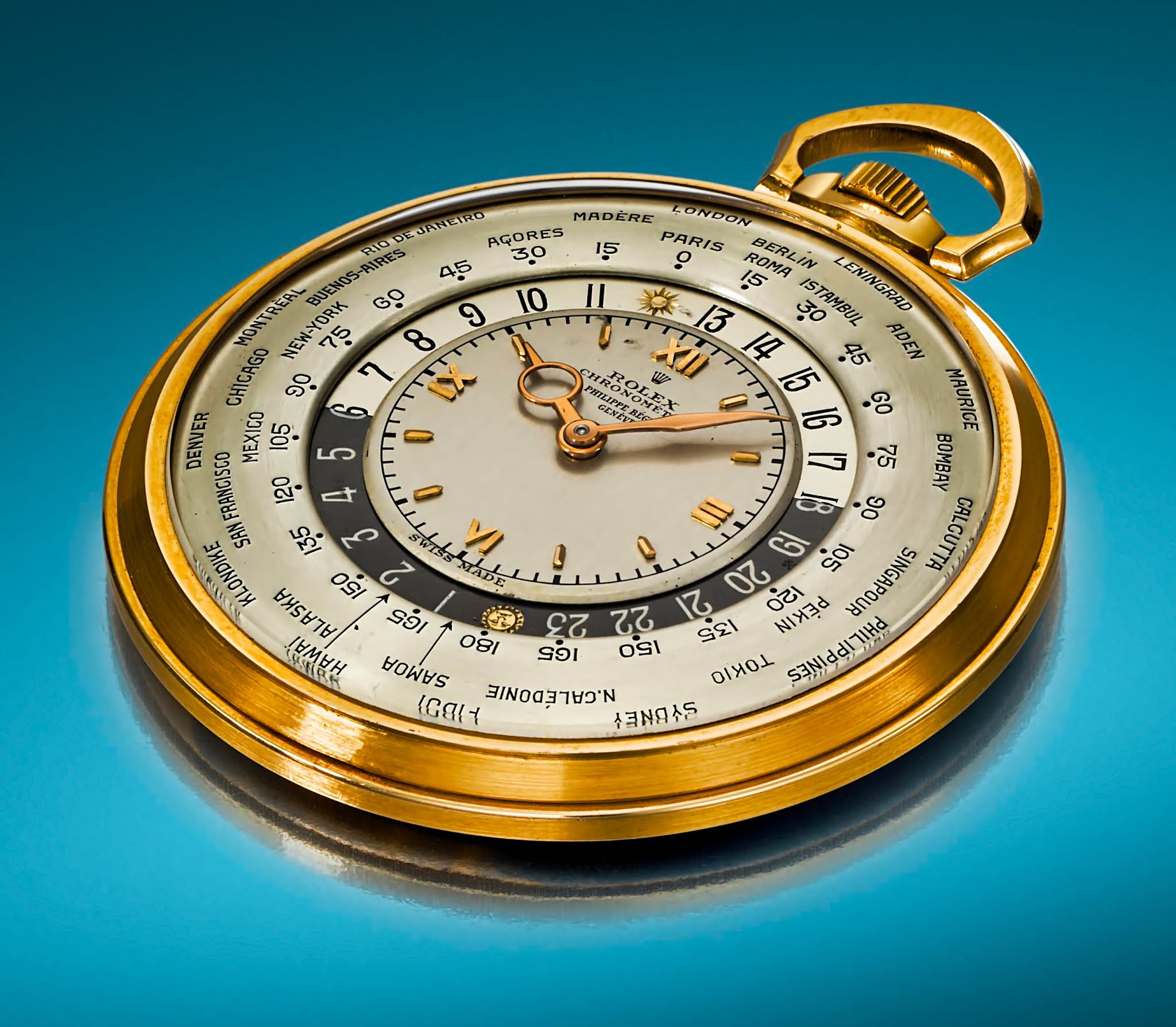


This exotic beauty was made in 1943, even though for some strange reason Christie's refers to it as being "CIRCA 1945".  You can read much more about the history of the Rolex World Timer in Jose's brilliant article below. Cottier made 12 examples of this magnificent masterpiece for Rolex in two batches: 6 models in 1943, and another 7 in 1947/1948. To date there are four known: 2 from the first batch and 2 from the second batch.

Rolex World Time Pocket Watch

by 

By JOSE PEREZTROIKA


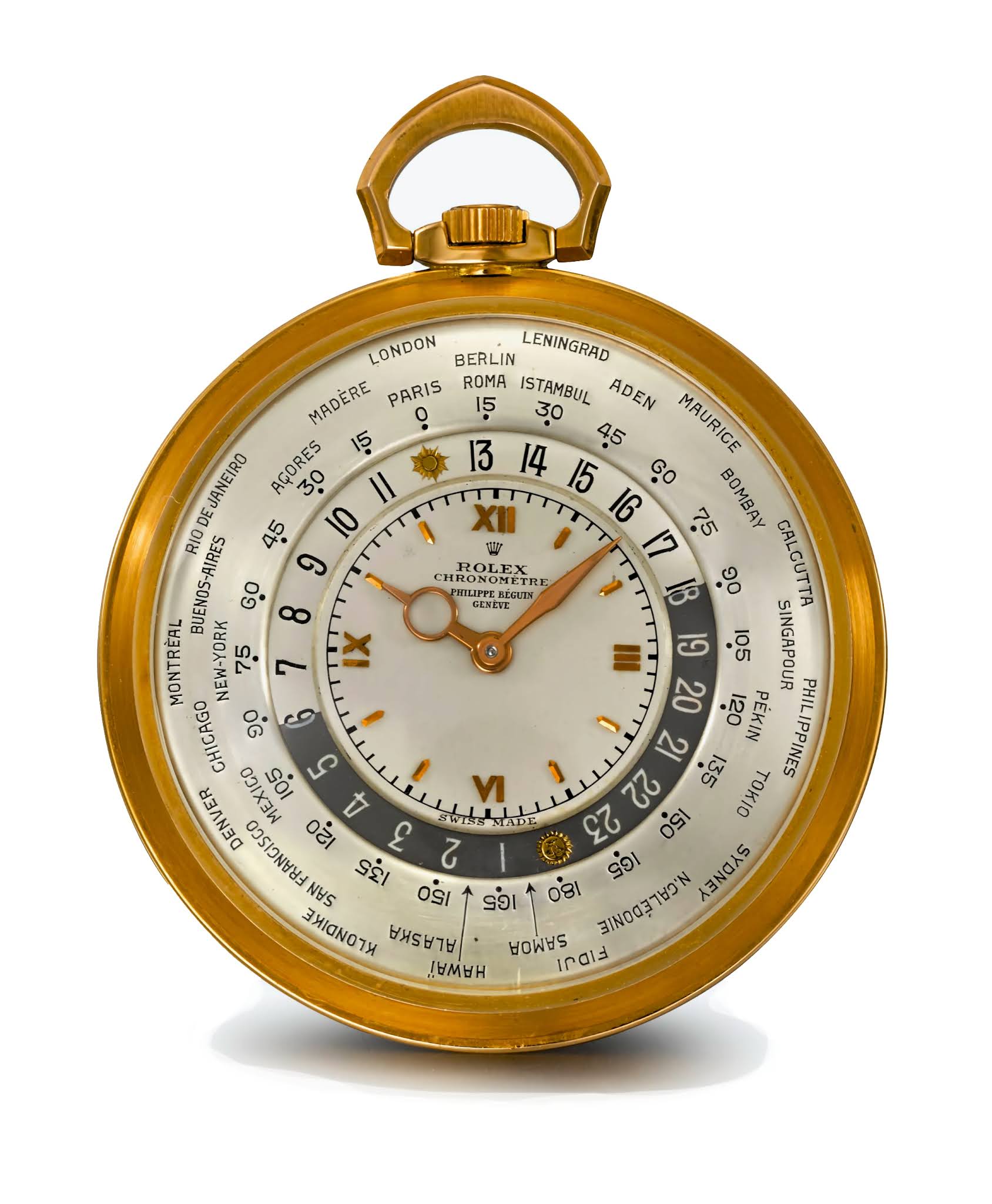
When you think of World Time or Heures Universelles, you probably picture a Patek Philippe in front of your eye—certainly NOT a Rolex. The stunning Rolex World Time pocket watch you are about to experience is therefore even more incredible.


The World Time concept was the brainchild of Louis Cottier which he developed around 1930. Cottier offered his invention to a variety of Swiss watch brands but as the owner of the patent, he insisted on modifying the movements himself. This was the standard procedure from the very first prototype for Baszanger in 1930 until the very last piece he was working on, when he died at his bench in September 1966.


Cottier's World Time was in many ways a precursor to the Rolex GMT-Master. From 1948 onwards, Rolex developed their own interpretations of the World Time concept and patented a number of ideas.

Swiss watch brands who comissioned World Time watches with Cottier were the crème de la crème of the Swiss watch industry: Vacheron & Constantin, Patek Philippe, Agassiz, Wittnauer, and Rolex!

You heard it right, Rolex was also a client of Cottier—one of the very first actually. In 1931, Cottier developed three different jump hour prototypes for Rolex but it was not until 1943 Cottier created a micro-series of six Rolex World Time pocket watches. The movements were based on large Aegler-made calibers used by Rolex exclusively for officially certified chronometer pocket watches with the regal-sounding name of "Prince Imperial". Each modified by Louis Cottier himself.

The cases for these exclusive watches were made by Manufacture Favre & Perret SA in La-Chaux-de-Fonds, Switzerland and the exceptionally beautiful dials came from none other than the renowned dial specialist Stern Frères.

Apart from the initial six examples, Cottier made another batch of six examples in 1947/48. In total, 12 pieces were produced, making this one of the rarest Rolex references ever made. This information is based on Cottier's own documentation.

Until just recently, only three watches were known to exist. One from the 1943 batch and two from 1947.

A stunning fourth example has now surfaced and will be auctioned by Christie's on November 12, 2018, in Geneva. This watch belongs to the first batch from 1943. The pink gold pocket watch appears to be in an extraordinary condition.


Christie's Lot 139


Rolex World Time Pink Gold Pocket Watch

Reference: 4262
Dial: World Time (Istanbul misspelled)
Case number: 1010380


The intricate World Time Complication displays the time in featured cities around the world. It also shows whether it is day or night in the corresponding areas—demarkated by the light/dark chapter ring that revolves every 24 hours.


An interesting fact about the first batch is Rolex was not happy with the way "Instambul" was written. In a letter from January 7, 1948, Rolex asked the dial maker Stern Frères to change "Instambul" to "Instanbul" with an N.

A funny detail of this letter is the date. Only seven days into the new year, the person who wrote it was still used to write 1947. Didn't this happen to all of us at some point?


"Messieurs, 

Conc. cadrans Tour d'heures universel commandés par la maison Cottier. 

Faisant suite à notre entretien téléphonique nous vous confirmons que ces cadrans doivent être exécutés exactement d'après la photographie galv. 4262 en votre possesion, en outre ils sont destinés à des boîtes ayant 38 mm. d'ouverture de lunette. 
Nous attendons un cadran pour la fin février comme vous nous l'avez promis.
Veuillez agréer, Messieurs, nos salutaftions distinguées."


English Translation

Gentlemen, 

Concerning the World Time dials ordered by the Maison Cottier.

Following our phone call, we confirm that these dials must be executed exactly according to the galv. photography 4262 in your possession, besides they are intended for cases with a 38 mm bezel. We are expecting a dial by the end of February as promised. Gentlemen, please accept our distinguished greetings.

It is interesting to note the letter implies the dials were ordered by Cottier and not by Rolex.

The next picture shows a Rolex World Time from the second batch made in 1948 where Instanbul was already written according to Rolex's request.


The movement of this watch is incredibly beautiful. This was the only pocket watch movement ever made by Rolex—respectively Aegler SA in Biel/Bienne. For more common pocket watches, Rolex used a variety of movements from other brands. For instance Cortebert, Montilier, Recta, etc.


An interesting feature of this movement is the "Rolex Patent Cap", a bridge that covers the balance wheel completely.

According to my database, the first movements of this type appeared around 1930/31 in observatory quality (pre COSC) "Prince Imperial" pocket watches.

The case back bears typical Rolex hallmarks from 1943. Clearly visible is the Helvetia hallmark (official symbol for 18k gold) with the town mark "C" for La-Chaux-de-Fonds. The hammerhead symbol with the number 115 is the so-called "Poinçon de Maître" and identifies the case maker. This case was made by Manufacture Favre & Perret SA.


31 Victoires Haute Precision refers to 31 awards won for outstanding precision.

The case number with 7-digits is a typical Rolex pocket watch number that started in 1926 with 1,000,000. After WW2, Rolex abandoned the 7-digit number and adopted a new 6-digit number instead.

As many of you may know, Rolex produced all Panerai watches until 1955/56. Interestingly, the first three batches of the iconic Ref. 3646 were recorded within the pocket watch range and not—as one would expect—within the Oyster range. As you can see in the picture below, the case number of this 3646 is very close to Rolex World Time presented in this article.


Image appears courtesy of Stefano Mazzariol


With the new "Panerai" batch from 1944, Rolex numbered Ref. 3646 with Oyster case numbers.

Coming back to the Rolex World Time pocket watch, although pocket watches are not very popular these days, it can be assumed this spectacular example — considering its rarity and condition — will fetch a considerable amount of money. A piece like this is certainly something for the real connoisseur.


Christie's description fascinatingly mentioned the following:

"Rolex was certainly experimenting with various world time systems as research into their Swiss patents shows. Between 1948 and 1950 Rolex had patented at least three various world time systems including one (Swiss patent no. 273742) with close visual similarities to Cottier’s. Quite why Rolex never put any other world time watches into full production can only be conjecture. 

However, looking at the wider picture, this was a period of experimentation and development of new models within the company, with the focus starting to switch to the robust tool and sports watches for which Rolex has since become synonymous. It was perhaps felt that a world time watch was uncommercial and too expensive to produce and by the early 1950s work on the new GMT-Master may have already begun."

Special thanks to John Goldberger.


A Note From Jake


Jose did such a great job with documenting and contextually showcasing this amazing Rolex history, which comes as no surprise. Jose constantly suprises and delights with his magnificent Horlogical Forensics Investigation technique.

Back on May 20, 2018, I published the story below, which I believe could almost serve as a Part II to Jose's story seen above, as it offers additional insight into the genesis of the Rolex GMT-Master. It also provides additional scholarship and insight while supporting Christie's brilliantly written description seen above this paragraph.


1949 Rolex GMT?

Rolex 'Universal Watch' Patent Application


WTCF!?!! This new find is rather shocking as it adds a previously undocumented piece of history to the Rolex GMT-Master history puzzle. Notice the application date is August 29, 1949. This is profound in that Rolex did not launch the Rolex GMT-Master until 1955.


I really don't even know where to begin with this Rolex patent application as is appears to have come out of left field. The fact that it predates the GMT-Master by 6 years is one thing, but the fact it has two dials with one that includes international cities including Geneve, Berlin, New York, and Panama make it even more interesting as it appears to be a hybrid GMT/World-Timer of sorts...


One interesting detail is that the Rolex 'Universal Watch' pictured above features a dedicated 24 hour hand (5) which we see just above the 2 O'clock position. This means that Rolex had the GMT-Hand design complete at least 6 years earlier than anybody ever documented. Clearly, this Rolex watch model never made it to market, but this patented design really illustrates that Rolex was swinging for the fences in watch design...

It is obvious to note the design of this 'universal watch' by Rolex is opposite of a GMT-Master in the sense a GMT has the 24-hour rotating bezel on the outside, whereas this design features it on the inside...


The photo above shows an original 1955 Rolex Pepsi GMT-Master, which is featured below in the 1955 Rolex ad.


Tuesday, November 16, 2021

SailGP: Making Major Advances at All Levels


SailGP


Making Major Advances at All Levels

In its second season, SailGP continues to push the boundaries of what is possible in yachting. This global championship, in which national teams race identical foiling catamarans at speeds exceeding 50 knots, is making further major advances in technology and innovation, sustainability and environmental awareness, as well as inclusivity. 


A 29-metre wing sail has been introduced to ensure intensive racing in even the lightest conditions, data analysts are playing a key role in improving boat speed, robotic buoys enable resource-efficient, environmentally friendly course settings, while influential female athletes are making their mark as valued team members. Above all, the season is showcasing human achievement as team leaders such as British sailing legend Sir Ben Ainslie and fellow luminaries share their skill and knowledge in the pursuit of perpetual excellence. 


Sir Ben Ainslie

 Rolex Prototype 


Hiding in Plain Sight


The fresh new Rolex SailGP video above features worlds best sailer Sir Ben Ainslie who our Captain Danny discovered wearing a Titanium Rolex Yacht-Master which is pictured below. This discovery caused a great deal of interest and speculation begging the question if Rolex will bring this really cool watch to life?


Yacht-Master 42 in Titanium


Sunday, November 14, 2021

Giuseppe Taddei & Rolando Panerai


Dueling Rolex Baritones @


Giuseppe Taddei & Rolando Panerai

1957 Teatro alla Scala. Milan, Italy  

Rolex Datejust v. Rolex Oyster Perpetual


My last post on Rolex's freshly released 'Perpetuating the arts for over four decades' post made me think about the fantastic photo below. Rolex has been an official partner of Teatro alla Scala for two decades. Rolex has had a long-standing and successful relationship with the world of opera, and many of the most famous opera singers wear Rolex watches.

Giuseppe Taddei & Rolando Panerai both rocking Rolex at Teatro alla Scala. Milan, Italy 1957

This photo above was taken in 1957 of two famous Italian Opera baritone singers in Milano, Italia at the worlds most famous Opera House—Teatro alla Scala.  In the photo above we see Opera baritone Giuseppe Taddei wearing a Rolex Datejust on a Jubilee Bracelet, with his good friend and fellow baritone, Rolando Panerai, who is sporting a Rolex Oyster Perpetual on an Oyster Bracelet. Teatro alla Scala was built in 1778 and is considered sacred ground for opera fans.


The Teatro alla Scala video below features Gianpaolo Marini who is the brother of the former Rolex CEO Gian Riccardo MariniGianpaolo Marini is the head of Rolex in Italiano, and in the video below he discusses Rolex's sponsorship of Teatro alla Scala.


In 2015 Gianpaolo Marini, Head of Rolex Italia wrote: For the nineth year running, Rolex joins La Scala as its Official Partner for the Saint Ambrose evening, which opens the 2015-2016 Season with Verdi's opera Giovanna dArco conducted by Riccardo Chailly.
 
Rolex’s role as a partner for the opening evening at La Scala began with Tristan and Isolde followed by Don Carlos, then Carmen, The Valkyrie, Don Giovanni, Lohengrin, La Traviata, Fidelio and now Giovanna d'Arco. Almost a journey through the history of music in the company of its greatest masters: Wagner, Mozart, Bizet, Verdi, Beethoven.
 
Rolex shares the profound values and distinctive excellence of La Scala’s traditions. It has been the opera house’s Official Timekeeper since 2006 and supports its many major projects, from the inaugural evening to international tours, landmark productions and special concerts. Rolex brand ambassadors, such as Placido Domingo, Cecilia Bartoli, Jonas Kaufmann or Gustavo Dudamel, have often appeared on La Scala’s stage.   
 
Over the years La Scala opera house has been Rolex Italia’s venue of choice to promote fund-raising initiatives or to celebrate important moments in its history, from the brand’s fiftieth anniversary to the opening of its new Milan headquarters housed in a palazzo on Via Manzoni close to the opera house.

Saturday, November 13, 2021

Rolex Perpetuating The Arts for Over Four Decades


Rolex Perpetuating The Arts for Over Four Decades

Friday, November 12, 2021

The Complete History Of Rolex Part 2: The André Heiniger Years


Note from Jake: I just completed a huge update to this amazing story, and I am certain you will love it. As I write this I am preparing to publish another epic story on Rolex Leadership which will boggle your mind!!! I don't have an exact date in mind, but plan to publish it sometime during the upcoming holiday season. In the meantime enjoy!


...Second Director of Rolex...


The André Heiniger Story

"Second Ghost In The Machine"

1921-2000

Rolex is an amazing company with an incredible history, coupled with an awe-inspiring legacy of success and achievement. In The Complete History Of Rolex Leadership Series on Jake's Rolex World, I have been exploring the history of Rolex's internal leadership, beginning with the founder of Rolex, Hans Wilsdorf.

Only six men have officially run Rolex in its illustrious history over the past 116 years. André Heiniger became the third Director General of Rolex in 1964, four years after founder, Hans Wilsdorf, passed away at age 78. André-Jean Heiniger's dedicated career with Rolex spanned 50 years from 1948 to 1998!!!

André-Jean Heiniger was born 
in La Chaux de Fonds, Switzerland on September 12, 1921, and was married to Odette Montandon. He earned a B.A. degree in Business Administration at Basel at the Mayenfels Institute in Pratteln, and also went to school in England. Heiniger spoke many languages fluently including French, German (German-Swiss dialect) Spanish, Portuguese, Italian and English, and has been described at a soft-spoken man. 

The photo below of André-Jean Heiniger was taken just after he took over as the official Managing Director of Rolex in 1964 when he was 43 years old. 


André Heiniger 1963

After college André went to work for a watch company in La Chaux-de-Fonds, Switzerland where he worked for 6 years specializing in manufacturing, and business administration. In 1948 he met Rolex Founder, Hans Wilsdorf who offered him an opportunity to develop the Argentinian market in South America, where he lived and worked for the next 6 years in Buenos Aires, Argentina while building out the South American market for Rolex.

While living in Beunos Aires, André and his wife Odette welcomed their only child in to the world when Patrick Heiniger was born on August 26, 1950. André-Jean moved has family back to Geneva and was appointed Director of Watches on January 11, 1955.

The photo below shows Rolex founder, Hans Wilsdorf attending his 75th Birthday Party in 1956. In this photo we see André-Jean Heiniger on Wilsdorf's left looking down at a Camera in his hand. This is the only photo I have ever seen that shows Heiniger with Wilsdorf.


The best scholarship to date suggests Rolex Founder, Hans Wilsdorf was so impressed with André-Jean Heiniger he chose him as his successor to run Rolex shortly before his death in 1960. The strange thing is Heiniger was not officially appointed Director General of Rolex until 1964. This appears to suggest Rolex was leaderless for the four years between 1960 to 1964.

The challenge is when a profound leader like Wilsdorf dies it can leave a huge void unfilled with 'big shoes to fill.' There is a previously undocumented flip side to the official narrative, which I learned from a source whom wishes to remain anonymous that suggests there was perhaps some infighting amongst the top Rolex leadership, and after significant wrangling Andre Heiniger prevailed—which would explain why he wasn’t officially appointed Director General for 4 years after Hans Wilsdorf’s death in 1960 until 1964. “  

The video interview below features Rolex Founder, Hans Wilsdorf right around the time he chose to pass the baton to Heiniger to succeed him as the leader of Rolex. To the best of my knowledge this is the ONLY video footage of Wilsdorf to ever be seen by the public.


Rolex was originally headquartered in London, England, but in 1928 Hans Wilsdorf decided to move Rolex Headquarters to Geneva in Switzerland. Rolex Headquarters remained at the humble location in the center of Geneva (as pictured below on the top floors) from 1928 to 1964. It is interesting to consider that Rolex successfully commercialized the waterproof Oyster case, from this building, as well as launching the Perpetual movement, along with the Datejust, Day-Date, Submariner, GMT-Master, and Explorer.

Rolex Headquarters in Downtown Geneva opened in 1928 and moved in 1965


It is fascinating to note that in the photo above there are zero cars parked along the sidewalk, but many bicycles, and of course we see the trolley tracks...

In the photo below we see Hans Wilsdorf in his Genevan Headquarters office in late 1953 reviewing watches with J. Farren-Price who was Australia's original Rolex agent.


"First we shape our dwellings, then our dwellings shape us." 

–Sir Winston Churchill


In 1964, after becoming Director General of Rolex Heiniger made a bold move and chose by moving Rolex's International Headquarters from downtown Geneva to the outskirts of Geneva where he erected a radical new state of the art Rolex Campus that was designed to stand the test of time.

André-Jean Heiniger built Rolex's bold new state-of-the-art International Headquarters in 1965 (pictured below) and in many ways it was designed and built like a Rolex—including its Bauhaus influenced late art-deco timeless design language. 


Ironically, Rolex today makes more Rolex watches per year—exclusively in Switzerland—than the made during their first half-century when the photo above was taken in 1965!?!! This is due in large part to intelligent long-term investments André-Jean Heiniger made in continuously improving Rolex's infrastructure.

The following two Rolex ads appear courtesy of the Concannon Collection and they offer insight into how proud Rolex was of the development and design of their new World Headquarters in Geneva. 


I highly recommend clicking on the magazine graphic above and reading the whole thing, which is absolutely fascinating. In particular, I am most fascinated with the last two paragraphs which say:

"The Rolex watches of today have reached such heights of precision, accuracy, and ruggedness that it is difficult to predict what the watches of tomorrow will be like.

Whether they will be in cases of titanium or solid synthetic diamond. Whether they will be powered by atomic energy or by sun. But one thing is certain. The finest watches of tomorrow will be built by the men at Rolex."


As Rolex kept growing and expanding André-Jean Heiniger kept modernizing and improving Rolex's headquarters. Years later he added a glass elevator well on the front facade that offers breathtaking views of Lake Geneva.


The following documents which appear courtesy of The Souham / S3C Private Collection offer valuable insight into André-Jean Heiniger's amazing career achievements which come forth from a biographical review from St. John's University which granted him an honorary Doctor of Laws degree which he was very proud of. 


Document above and below appears courtesy of Souham / S3C private collection 


In 1986 André-Jean Heiniger was the Chairman of the Board of Directors of Rolex as well as remaining the Managing Director of Mountres Rolex S.A. In modern nomenclature Managing Director would be the same as Chief Executive Officer (CEO). 


The Quartz Crisis

How André-Jean Heiniger Protected Rolex

A Swiss consortium named Beta 21 worked on developing Quartz technology which included many famous Swiss brands like Patek Philippe, Omega and Rolex. In 1967 they developed a the first Quartz based functional proof-of-concept prototype named the CEH 1020 which was built by François Niklès and Jean Hermann in July of 1967. 

Long story short, the Swiss could not figure out what to do with the Quartz technology as they were rightfully worried it might obsolete their core manufacturing prowess with mechanical movements. The Japanese saw this as an opportunity and took advantage by flooding the international marketplace with cheap quartz watches. André-Heiniger took decisive action by moving Rolex upscale and converting it from a company that made 'Good Watches' to a Luxury Goods company. Ironically Rolex had invested a tremendous amount of resources into developing super innovative Rolex prototypes that to this day have never seen the light of day.

One really great question in my mind has always been if Hans Wilsdorf had lived 20 years longer, how would he have reacted to quartz technology. Would Wilsdorf have embraced Quartz, or would he have rejected it? At this point the question is purely academic, but one thing we know to be a fact is André Heiniger took advantage of the "Quartz Crisis" opportunity by consolidating Rolex's position in manufacturing and in the marketplace.  

As an insurance policy, Rolex introduced a number of Oyster Quartz models that were innovative, but Heiniger strategically positioned them as an inferior option by keeping their retail prices lower than the comparative mechanical models. This strategy went on for a quarter century, until Rolex in 2004 completely discontinued all quartz watches under Patrick Heiniger's leadership.


1971 Rolex Explorer II
Reference 1655

Rolex introduced the Explorer II in 1971 under André Heiniger's leadership and it had an orange hand to keep track of the time of day and night time. The current orange hand Rolex Explorer II  is based upon this cool retro-design.


Rolex Day-Date Ad
January 1973


This fascinating Rolex advertisement was published in a magazine in January of 1973, and it says: "There's a private corridor outside the Managing Director's office in our Geneva headquarters which is lined with the signed portraits of most of the world's leading Heads of State." Obviously this is André Heiniger's office.


If Only These Walls Could Talk

Below is a higher-resolution photo of the executive offices at Rolex Headquarters in Geneva in 1973. It is clear, that at least back in 1973, Rolex was very proud and interested in their history. What I want to know, is where are all those photos today? I want to see them and learn more about the amazing history of Rolex. I imagine André Heiniger's office is the one at the end of the corridor?


1976 Rolex Awards For Enterprise Founded

In 1976 André Heiniger founded the Rolex Awards for Enterprise to mark the 50th anniversary of the founding of the waterproof Rolex Oyster watch. Originally they were named "Spirit of Enterprise Awards", but were changed to "Rolex Awards for Enterprise."


In the photo below we see André Heiniger in 1976 celebrating the 50th anniversary of the Rolex Oyster where Rolex announced the Spirit of Enterprise Awards. In this photo we see (from left to right) racing legend, Sir Jackie Stewart, Odette Heiniger, André Heiniger, Her Imperial Highness, Princess Napoléon, and legendary Olympic Skier, Jean-Claud Killy. Photo appears courtesy of S3C Private Collection.


Photo appears courtesy of Souham / S3C private collection 


The photo below shows the judges for the original Rolex awards. From left to right we see Luis Marden (whose real name was Annibale Luigi Paragallo). Luis Marden was a famous American photographer for National Geographic, as well as being a diver and filmmaker. Next up we see Professor, Oliver Reverdin who was a scientist, journalist and politician, then Professor Derek Jackson who was a spectroscopist and atomic physicist. Next we see André Heiniger with Professor Jacques Piccard on the end. Photo appears courtesy of S3C Private Collection.


Photo appears courtesy of Souham / S3C private collection 

Luis Marden who is pictured above on the far left is featured below in the 1976 Rolex Submariner ad.


Below is a photo from the 1978 Rolex Awards for Enterprise and we see Andre Heiniger (second from left) standing next to legendary Swiss explorer, Jacques Piccard.  On the far left we see Kenneth Marten, who was a 1978 Rolex Laureate along with Bill Lasley who has a mustache along with Francine Patterson who has long blond hair.


Photo appears courtesy of Souham / S3C private collection 


1978 Rolex Awards Ad


The next two images below were published in 1978 by Rolex in magazines. The first image is fascinating because it appears to be a wrist shot of sorts, but if you examine it closer, you might notice the remarkable similarity to the Rolex crown logo.


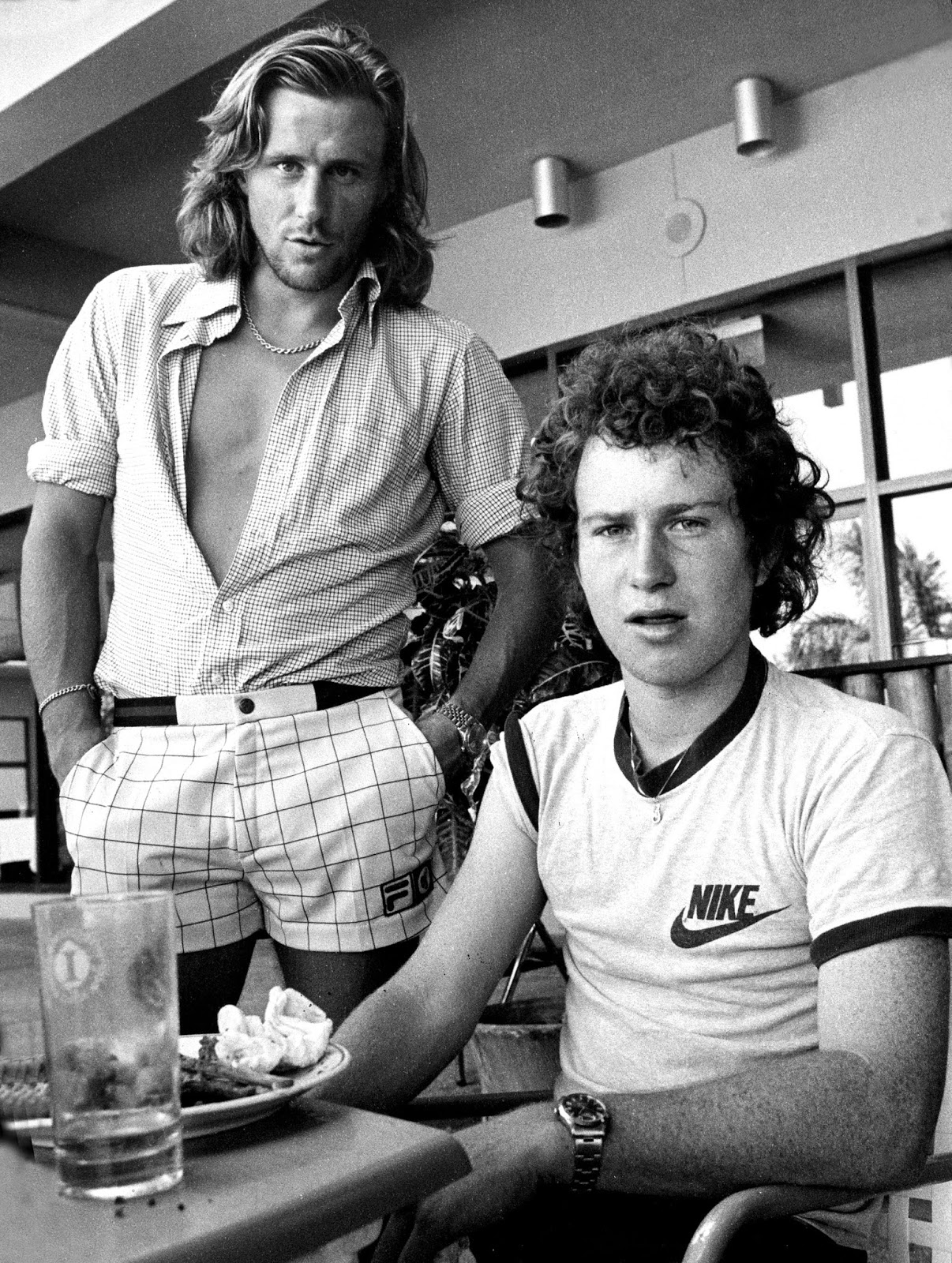
In the photo below from 1980 we see André Heiniger with legendary tennis star, Bjorn Borg on June 11 0n the evening of Men's singles finals at Wimbledon. The 1980 Wimbledon Men's final match was between Björn Borg and John McEnroe was a dramatic struggle which went on for a long time with Borg prevailing. 


Photos appear courtesy of Souham / S3C private collection 


I would be remiss if I didn't mention that I always found the body language in the photo below to be ironic as Björn Borg had just slayed McEnroe in the Men's Wimbledon Finals and in the moment that photo was taken was King of the World, yet he has his arms crossed in a defensive posture. Couple this with André-Jean's body language which is the complete antithesis of Borg, in the sense he looks like he just won Wimbledon :-)


In the photo below taken back in the early 1980s, we see Björn Borg and John McEnroe and they are both wearing Rolex Datejust watches.


André-Jean Heiniger's Rolls Royce pictured on the cover of a Rolex DAY-DATE Booklet

There is a famous story where a friend of André Heiniger asked him "How's the watch business doing?" to which André Heiniger responded "I have no idea." His friend laughed, not realizing that André was being serious. André continued "Rolex is not in the watch business. We are a luxury business."


This next photo is of somewhat profound significance as it was taken at the Maxi Yacht Rolex Cup in Porto Cervo, Sardinia and shows André Heiniger and his wife Odette in 1995 with then President of Rolex Italy, Gian Riccardo Marini who went on to become the CEO of Rolex in May of 2011


André and Odette Heiniger are pictured below with His Highness, The Aga Khan at the same event.


André Heiniger's son Patrick Heiniger became the Managing Director of Rolex in 1992 when the Rolex Board of Directors appointed him to replace his father. Patrick Heiniger stepped down as CEO of Rolex on December 17, 2008.

André Heiniger is pictured below with his son Patrick Heiniger who became the CEO of Rolex after him. Golf legend, Arnold Palmer is pictured on the left wearing a tuxedo jacket.


Arnold Palmer, André Heiniger and Patrick Heiniger pictured above

André Heiniger stayed on as the Chairman of Rolex until he retired from that role in 1998, and then became Chairman emeritus until he passed away three years later On January 3, 2000 at the age of 79. Over the 34 years André Heiniger ran Rolex he assisted in turning it into the ultra-succesful company it is today. I am looking forward to shedding much more light on this illustrious Rolex historical figure.

The reason the sub-title of this part of this story is "The Second Ghost In The Machine" is because so little has ever been published about André Heiniger. André Heiniger was a very private man who maintained a very low-key public presence.

To date, André Heiniger has remained an enigmatic figure, and one could argue that history–like with Hans Wilsdorf, founder of Rolex before I wrote Part 1 of this Rolex Leadership Series–almost seems to have forgotten him. I intend to change that in 2012 by walking you through his amazing career achievements and exploring what made him tick.


André Heiniger is pictured below with his wife, Odette Heiniger, Colonel Gerard Leigh and Price Charles of Wales at the Guards Polo Club in Windsor, U.K.

Photo appears courtesy of Souham / S3C private collection 

In this next photo, we see Gérard Souham, André Heiniger, Jan Nelson and Prince Charles.


Photo appears courtesy of Souham / S3C private collection 


Photo appears courtesy of Souham / S3C private collection 

In the next image we see André Heiniger with HIH The Princess Napoleon at a Polo match.