Operation Tektite
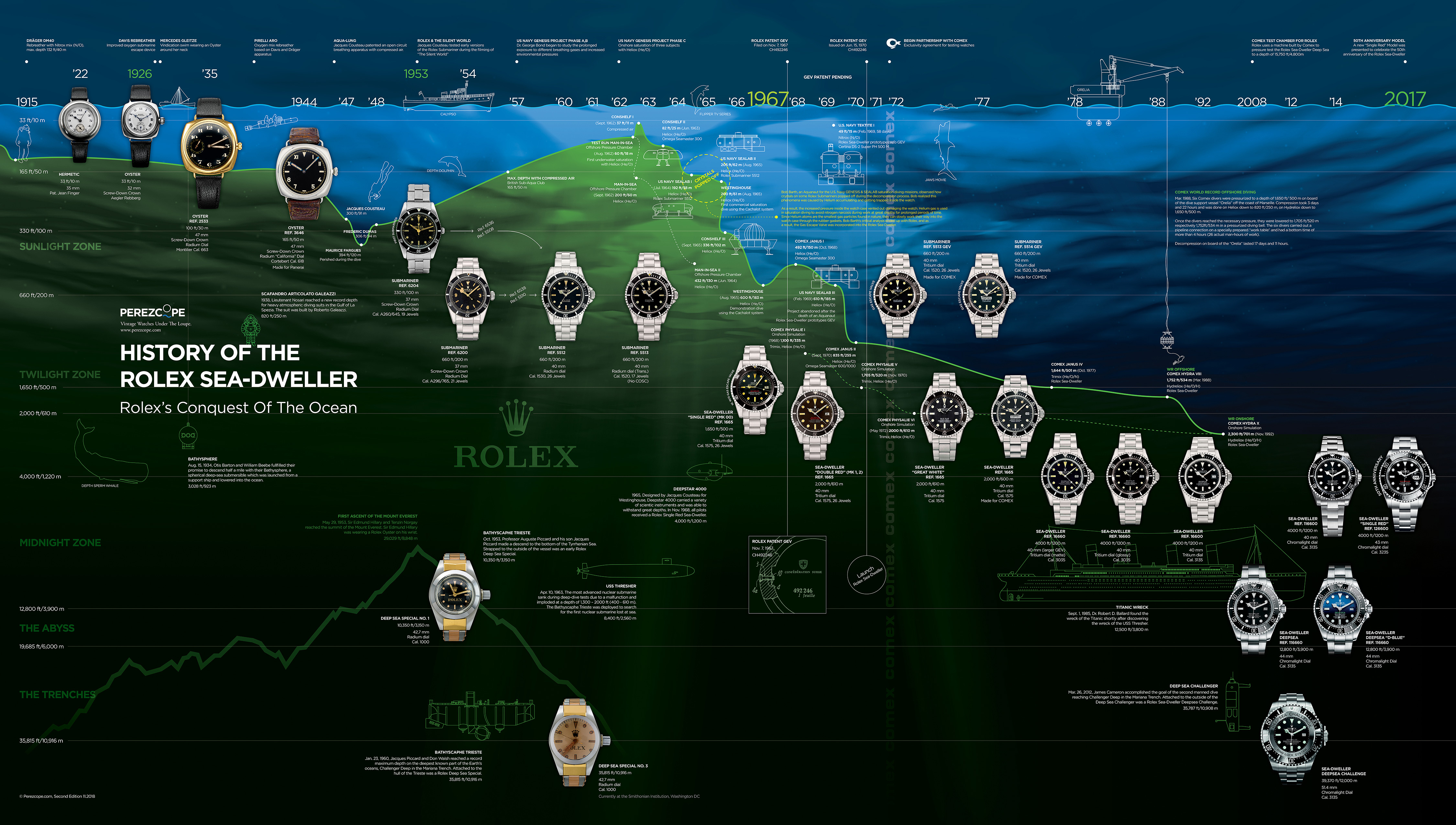
As the U.S. Navy had begun winding down Operation SEALAB in 1969, Rolex continued to test SEA-DWELLER Prototypes with The U.S. Navy Office of Naval Research Operation Tektite, which had an underwater habitat in Great Lameshur Bay, in The Saint John, U.S. Virgin Islands.
The Tektite habitat was built by the Space Division at General Electric at the Valley Forge Space Technology Center located in King Of Prussia, in Pennsylvania. Tektite I was a mission with four aquanauts, and it began on February 15, 1969 and ran until April 15, 1969.

I'd like to be under the sea
In an octopus' garden in the shade
He'd let us in, knows where we've been
In his octopus' garden in the shade
I'd ask my friends to come and see
An octopus' garden with me
I'd like to be under the sea
In an octopus' garden in the shade.
We would be warm below the storm
In our little hideaway beneath the waves
Resting our head on the sea bed
In an octopus' garden near a cave
We would sing and dance around
Because we know we can't be found
I'd like to be under the sea
In an octopus' garden in the shade
We would shout and swim about
The coral that lies beneath the waves
(Lies beneath the ocean waves)
Oh what joy for every girl and boy
Knowing they're happy and they're safe
(Happy and they're safe)
We would be so happy you and me
No one there to tell us what to do
I'd like to be under the sea
In an octopus' garden with you
Operation Tektite I was an experiment between NASA psychologists and Office Of Naval Research psychologists to study the potential long-duration ramifications of spaceflight, thought studying saturation dives. The premise was simple. The notion was: “behavioral, habitability and crew effectiveness data obtained in observations of undersea teams could be used to predict and understand similar problems involving space teams.”

Ian Koblick was one of the aquanauts on Tektite I who wore a prototype Rolex Single Red SEA-DWELLER. Ian Koblick is pictured above and below wearing his Rolex Single Red SEA-DWELLER prototype [Reference 1665].
Ian Koblick's prototype 1967 Rolex Single Red SEA-DWELLER that he wore during Project Tektite I is pictured below in a recent photo. To date, none of of the Single Red SEA-DWELLER prototypes from Tektite have appeared with helium release valves, which is strange for a few reasons. It might have something to do with the fact that the Tektite Habitat was in fairly shallow water, so maybe Rolex felt they did not need SEA-DWELLER models with the HRV. I believe there is one known example of the Single Red SEA-DWELLER that does have a helium release valve, but I don't know if it was from Operation Tektite.
In the photo below we see Ian Koblick pictured on the left, talking with an agent from the United States Ministry Of Interior. Pictured on the right is Richard A. Waller who is wearing his prototype Single Red Rolex SEA-DWELLER prototype.
The Omega French Connection
Rolex officially launched the SEA-DWELLER [Reference 1665] to the public in 1971/1972. In a bizarre twist of fate, COMEX divers had been wearing and testing prototype OMEGA SEAMASTER models. The Omega magazine ad below announced the relationship between Omega and Comex.
COMEX wore and tested OMEGA "Ploprof" models [Reference 3350: Caliber 1002]. The photo below shows a really cool OMEGA SEA-MASTER Ploprof prototype that has COMEX and JANUS II engraved into the case. COMEX's JANUS II diving program began in 1970, thus COMEX could not have been working with Rolex on the development of the Helium Release Valve that was incorporated into the SEA-DWELLER prior to 1969.
Also, in an interview with COMEX's founder, Henri-Germain Delauze back in 2009 he specifically told me COMEX had been testing watches for Omega, when Rolex CEO, André Heiniger came to visit him in 1971, and offered to equip his entire team of DEEP-SEA divers with ROLEX/COMEX watches. Henri said, once that happened, we were completely done with Omega!
The Omega Magazine Advertisement below confirms this fact.
Inner Space Race
The photo below shows a really cool prototype Titanium OMEGA SEAMASTER 1000 Polprof that was tested by COMEX in 1971, just before they switched over to Rolex. The OMEGA Polprof worked in the opposite way of the Rolex SEA-DWELLER in the sense that instead of having a helium release valve, it was so sealed up that it would not allow helium to enter the case to begin with. Also, if you look closely at the OMEGA polprof, it kind of looks like a vintage Panerai case with the half-crescent crown protection system.
It is worth noting that Omega filed a patent for the SEAMASTER Polprof in 1967, which was the same year Rolex filed it's patent for the Helium Release Valve. The Polprof featured an interesting feature that locked the bezel and stopped it from being able to spin, unless you pressed on the orange button, thus requiring two hands to operate, whereas the Rolex Submariner and SEA-MASTER only rotated counter-clockwise, so you could not add time by mistake.
Henri-Germain also told me in an interview, COMEX never had any involvement in the development of the SEA-DWELLER or the Rolex Helium Release valve. An obvious question is why did Rolex offer to equip COMEX with Rolex watches? Was it because they thought they had lost to Omega in the field of outer space, so they wanted to make sure they dominated inner space?
Or maybe it was because there was other real possibility to test dive watches under real life conditions? Also, it may have had to do with the fact that Rolex was worried Omega was going to try and dethrone them with the SEA-MASTER Polprof, so they stepped up their game!?!!
The following letter from the Director of Rolex in Geneva regarding Rolex Singapore is fascinating as it discusses the testing of a Rolex SEA-DWELLER Prototype, and how COMEX had recently taken over testing in early 1972.
The photo below is the first known photo of Henri-Germain Delauze wearing a Rolex Submariner and it was taken in 1972. Henri-Germain sent me this image with a bunch of photos from his archive.
Another obvious question is if Rolex developed the SEA-DWELLER in 1967, how is it that the U.S. Navy SEALAB and Tektite operations did not receive and start testing them until 1969? This is simple to answer when you do the math. The Rolex patent application stated the Rolex SEA-DWELLER was not first used until November 6, of 1967. SEALAB (and assumably Tektite] received their prototype Rolex SEA-DWELLER prototypes in January of 1969, which was fourteen months later. This was due to the fact Rolex had to wait until SEALAB 3 and Tektite I were launched, as nobody else was conducting such deep saturation dives that placed aquanauts in undersea dwellings under real life conditions.
So if the Rolex SEA-DWELLER was developed and tested by The U.S. Navy SEALAB and Operation Tektite, who ended up being the ultimate beneficiary of the SEA-DWELLER? A French company named COMEX!
Rolex COMEX SEA-DWELLER Ads
Rolex never sold Submariner or SEA-DWELLER models with the COMEX logo designation to the public, but they showcased their relationship with COMEX in magazine ads for the Rolex SEA-DWELLER. This first Rolex SEA-DWELLER ad is from 1975 and it features the amazing DOUBLE-RED SEA-DWELLER dial designation that is highly coveted by collectors.
Alain Jourde and Claude Boardier are featured in the Rolex COMEX magazine above and in this photo from the COMEX archives we see them in the COMEX habitat both sporting their Rolex SEA-DWELLER models. Of course, 610 Meters is equal to 2000 feet. 51 Heures when translated from French to English means 51 hours.
Rolex continued development of the Submariner and SEA-DWELLER through the 1970s, and continued to support research programs that depended upon the Submariner, as seen below in this 1975 Rolex ad featuring Dr. Joe Macinnis.
The 1975 Rolex Ad below features Peter Benchley in a Rolex Submariner ad. Peter Benchley was good friends with T. Walker Lloyd.
Conclusion